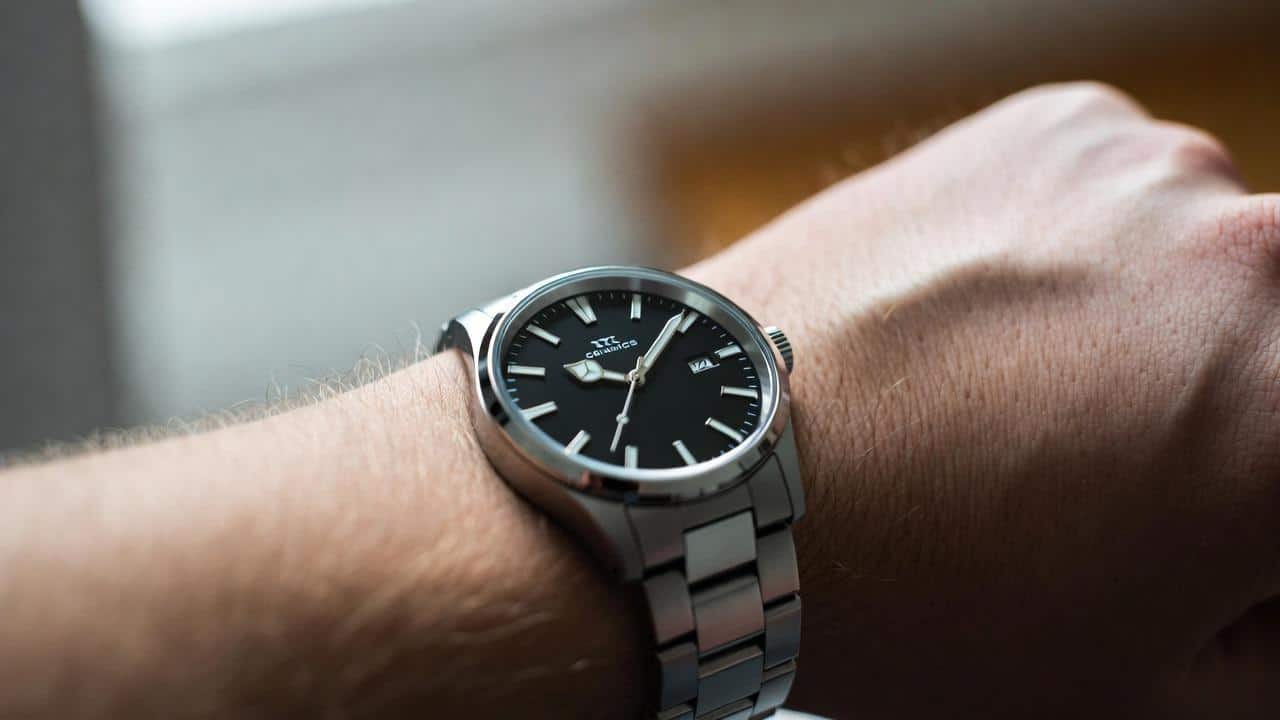
The best everyday watch is the one you forget you are wearing. It reads clearly at a glance, fits your wrist without pinching, survives rain, hand washing and the occasional knock against a door frame, and looks fine with both a T-shirt and a shirt and tie. In practice that usually means a case of 36 to 40 mm, a plain dial, 50 to 100 metres of water resistance, and a movement that does not ask for much attention. This guide walks through how to choose one, what the numbers on the spec sheet really mean, and which kinds of watches have earned a place on wrists for years.
Product offers are temporarily unavailable.

What “everyday” actually means
Watch people often call this idea a GADA watch: go anywhere, do anything. It is not a category with strict rules, more a set of habits. An everyday watch gets worn on the commute, at a desk, on a Saturday hike that was supposed to be a short walk, and at a dinner where nobody will look at your wrist anyway. It is allowed to pick up scratches. It is not allowed to be fragile, fussy or so loud that it dominates the outfit.
That changes how you shop. A watch that looks stunning in a photo but needs careful handling is a special-occasion watch, and there is nothing wrong with owning one. But it is a different purchase. For daily wear you want to judge a watch on boring things: how easy it is to read, how it feels after eight hours, whether the strap annoys you, and how often it needs care. Those boring things decide whether the watch ends up on your wrist or in a drawer.
Start with size and fit
Size is the mistake people make most often, and it is the one that is hardest to fix after buying. Diameter is only the first number. A 38 mm watch with long, curved lugs can overhang a small wrist. Meanwhile, a 40 mm watch with short lugs can look neat. If a retailer lists lug-to-lug length, use it. As a rough guide, the lug-to-lug distance should not be wider than your wrist when you look at it from above.
Thickness matters just as much for daily wear. A thin watch slides under a cuff without a fight. A thick one catches on sleeves and tires your wrist at the end of the day. Automatic watches are usually thicker than quartz ones because the movement is bigger. So if you wear shirts with fitted cuffs, check this number before you fall for a design.
Lug width is the quiet detail that decides how flexible the watch will be later. Most everyday watches use 18, 20 or 22 mm lugs, and 20 mm is the easiest size to find straps for. A watch with standard lug width lets you swap a bracelet for leather or a woven strap in a minute, which is the cheapest way to make one watch feel like two.
If you are not sure what suits you, aim for the middle. Case sizes of 38 to 40 mm suit a wide range of wrists, and they have stayed fashionable for decades because they do not look too small or too large next to a sleeve. Small wrists often prefer 34 to 38 mm, and larger wrists can carry 40 to 42 mm without a problem.
Movement: quartz, solar or automatic
The movement is the engine, and for daily use it matters more than the brand name on the dial. There are three sensible options, and none of them is wrong. They just ask for different things from you.
Quartz
A quartz watch uses a small battery and a vibrating crystal. It is accurate, light, cheap to make and cheap to look after. Some quartz watches are accurate to within a few seconds a month. The cost of that simplicity is a battery change every few years. If you want to know more about what happens inside, our explainer on how a quartz watch works covers it in plain language.
Solar quartz
A solar watch is quartz with a clever power source. Instead of a replaceable battery it has a rechargeable cell, which is topped up by light through the dial. Citizen introduced its Eco-Drive, the first light-powered analogue quartz watch, back in 1976, and the maker says a full charge keeps a typical model running for more than six months in total darkness. Ordinary indoor light also charges the watch, which is why a solar watch that sees daylight through a window every so often just keeps running.
Automatic
An automatic watch is purely mechanical, with a rotor that winds the mainspring as your wrist moves. It has no battery at all, and for many owners that is the whole attraction. The trade-off is that it is usually less accurate than quartz, it stops if you leave it alone for a couple of days, and it wants a service every few years. Seiko’s popular 4R36 movement, for example, has 24 jewels, beats at 21,600 vibrations an hour and has a power reserve of about 41 hours. So a watch left on the desk over a long weekend will probably have stopped by Monday.
| Movement | What it needs | Strong point | Weak point |
|---|---|---|---|
| Quartz | New battery every few years | Accurate, light, low cost | Less of a mechanical charm |
| Solar quartz | Regular exposure to light | No battery swaps for years | Needs light, cell ages eventually |
| Automatic | Regular wear, service every few years | Mechanical interest, no battery | Thicker, less accurate, stops if unworn |
| Hand-wound | A few turns of the crown daily | Slim and honest | You must remember to wind it |
Which one to pick
If you simply want the watch to be ready every morning, choose quartz or solar. If you enjoy the ritual and do not mind a stopped watch now and then, an automatic is a rewarding choice. A hand-wound watch is the most ritual-heavy of all, and it suits people who like starting the day by turning a crown.
Water resistance without the myths
The number on a case back is one of the most misread details in watches. “30 m” does not mean the watch can go 30 metres deep. It is a lab test pressure, and the standard behind it for ordinary watches, ISO 22810, is about testing and marking. Divers’ watches have a separate and much stricter standard, ISO 6425, and they say so on the dial.
In everyday terms, 30 m means splashes, rain and washing your hands. Casio states plainly that its classic F-91W, which is marked 30 m, is fine for washing up or a sudden shower, not for swimming. A 50 m watch copes with a brief shallow dip. At 100 m a watch is built for swimming and splashing around in the sea, which is why many makers use it as the sensible baseline for a go-anywhere watch. Seiko rates its 5 Sports line at 100 m, for example.
Two habits matter more than the number. Do not press buttons or pull the crown while the watch is wet, and get the gaskets checked whenever the case is opened, for instance at a battery change. Rubber seals age, and a watch that was 100 m resistant in the shop may not be after ten years. Hot showers and saunas are hard on seals regardless of the rating. So many owners take the watch off for them.
Case, crystal and strap
For daily wear, stainless steel is the default for good reason. It is tough, easy to clean and handles decades of use. Resin cases are lighter and almost indestructible in ordinary life, and a resin watch can be a very smart pick if you work with your hands or want something you never have to think about. Titanium is lighter than steel but costs more.
The crystal is the glass over the dial, and it is where scratches show up first. Mineral glass is the common choice on affordable watches and is harder than acrylic. Hardlex is Seiko’s own hardened mineral glass, and many 5 Sports models use it. Sapphire is the scratch-resistant option and it is found on watches like Hamilton’s Khaki Field Mechanical. But it costs more and can chip on a hard impact. Whichever you choose, a flat or lightly domed crystal is easier to live with than a tall dome that catches the light.
Do not underestimate the strap. A bracelet is the practical choice for heat, travel and wet days. A leather strap is dressier but suffers from sweat and water, so keep it for the office. Nylon and fabric straps are light, cheap and washable, and they look at home on a field watch. If you like variety, remember the earlier point about lug width: standard widths make strap changes easy. Our guide to leather strap watches is a good place to start if you want a classic look.
Five types of everyday watch that keep earning their place
You do not need a long shortlist. These are the styles that show up again and again in real life, with a few well-documented examples of each.
The digital classic
The Casio F-91W has been in production since 1989. It has a resin case measuring about 38 by 35 mm, weighs around 21 grams, shows the time, date, alarm and a stopwatch, and has a backlight. Casio quotes a battery life of about seven years from its CR2016 cell, and its accuracy is rated at roughly 30 seconds a month. It is rated to 30 m. It is light enough to forget and cheap enough that losing one is not a disaster, which explains why it has sold for more than three decades with almost no design changes.
The field watch
The field watch was designed to be read at a glance, and that is exactly what an everyday watch wants. Hamilton’s Khaki Field Mechanical is the well-known example: a 38 mm steel case, 9.5 mm thick, with a hand-wound H-50 movement that has an 80-hour power reserve, a sapphire crystal and 50 m of water resistance. That long reserve means it will still be running after a weekend untouched, which solves the main annoyance of mechanical watches. Hand-winding is a small ritual, but a pleasant one.


The sporty automatic
The Seiko 5 Sports range is the usual recommendation if you want an automatic that can handle a gym bag. Most models use the 4R36 movement mentioned earlier, have 100 m of water resistance, a day and date display, a screwed-down see-through case back and a Hardlex crystal. They also come in several case sizes, from about 36 mm to 42.5 mm depending on the model. So check the exact size before you choose a colour. They can be hand-wound as well as self-winding, which helps when the watch has stopped.
The light-powered watch
If you do not want to think about batteries at all, a solar watch is the quiet winner. Citizen says an Eco-Drive on a full charge keeps running for over six months in the dark, and its support pages give a rough guide: about two minutes of direct sunlight gives around a day of running, and a full charge in strong sun takes a matter of hours. In normal life the watch simply charges as you wear it. Citizen also launched the Eco-Drive 365 in 2023, which can run for a year on a full charge. For a hard-to-kill daily watch, the combination of solar power and a steel case is hard to beat.
The easy-going quartz
Timex’s Weekender line is a good example of a watch designed around ease. It has a 38 mm case, a quartz movement, mineral glass, a 30 m water rating, the Indiglo night light that Timex developed in the early 1990s, and a slip-through strap you can change without tools. The case is brass, so it is not the toughest. But the whole package is light, simple and comfortable, which is exactly what people mean by “weekend” watch. If you want a dependable and relaxed look, a design like this is worth checking.
Choosing a watch for everyday use: match it to your day
It helps to think about the typical week rather than the best case. Here is how the choices play out in a few common situations.
The office. A slim case in the 36 to 40 mm range, a clean dial and a strap that suits your shoes. A quartz or solar watch is perfect here because it just works. If you wear suits often, take a look at our guide to dress watches, since formal clothes can ask for a thinner case than a field watch has.
The outdoors. Choose 100 m of water resistance, a strap that handles sweat and rain, and a dial with strong lume. A resin or steel case on a nylon or bracelet setup is a safe choice. Mechanical watches can do it too. But a hard knock is a greater risk for them than for a quartz watch.
The commute and travel. This is where solar and quartz watches shine, because there is nothing to wind and nothing to set. A watch with a date and a clear second hand is useful when you are coping with new time zones, and a light, rugged case is happy in a bag.
A smaller wrist. Look for 34 to 38 mm cases with short lugs, and be careful about thickness. Several field watches and mid-size sports watches come in smaller versions, and a few brands make dedicated sizes for smaller wrists.
A tight budget. Everyday watches do not have to be expensive. A basic quartz or digital watch covers daily needs perfectly well, and our lists of the best watches under $100 and the best watches under $500 show what each step up actually buys you.
Mistakes to avoid
Most disappointment comes from a short list of avoidable errors. Buying on the diameter alone is the first, and we covered why. The second is trusting a depth number: a 30 m watch is not a swimming watch, whatever the label seems to imply. The third is choosing a watch that is too fancy for real life, with a polished case that shows every scratch and a strap that hates rain.
Other common mistakes are smaller. Some people buy an automatic and then leave it in a drawer, so it stops and never gets set. Others forget to check the lug width and cannot find straps. A few pick a dial that looks good in photos but is hard to read in low light, which matters a lot for something you check dozens of times a day. And some pay for a name instead of what they will actually use. A plain watch from a maker with a long track record often serves better than a trendy fashion piece, as the discussions in our posts on MVMT watches and the Swatch Big Bold quartz show.
Looking after an everyday watch
A little care keeps a daily watch going for decades. Rinse it with fresh water after the sea or a chlorinated pool, then dry it. Keep it away from strong magnets, which can upset a mechanical movement, and be aware that phones, speakers and some bag clasps contain them. Do not press buttons or turn the crown underwater or when the watch is wet.
Plan on a battery change every few years for quartz, and ask the watchmaker to check the gaskets while the case is open. For an automatic, wear it regularly or set it and wind it by hand if it has been resting. A service every few years, as the maker recommends, is cheaper than a repair after the oil has dried out. If you swap straps, wipe the lugs and spring bars so dirt does not wear through the finish.
Product offers are temporarily unavailable.
Where to go next
If you already know your budget or your style, these guides go into specific models in more depth:
- Simple, durable quartz and digital models: the best watches under $100
- Automatics, divers and solar watches: the best watches under $500
- Best cheap automatic watches if you want a mechanical movement
- A classic look: the best leather strap watches
- Work and formal wear: the best dress watches
- Our hub of affordable watches to compare across brands
- All watch buying guides
You may also enjoy our reviews of Tool Watch Co, Akribos, Oceanic and the Casio Waveceptor atomic digital for more everyday options.
Everyday watch FAQ
What size is best for an everyday watch?
For most wrists a case between 36 and 40 mm is the comfortable range, and 38 mm is a safe starting point. Check the lug-to-lug length and the thickness as well as the diameter. A 40 mm watch with short lugs can sit better than a 38 mm watch with long ones.
How much water resistance do I need?
For washing hands, rain and sweat, 30 m is enough. If you want to swim in the watch, look for 100 m or more and a rating the maker itself says is fine for swimming. None of these numbers are dive depths, they are test pressures.
Quartz, solar or automatic for daily wear?
Quartz and solar need the least attention. An automatic is more fun and more traditional. But it wants to be worn most days or wound by hand, and it needs a service every few years.
Is a digital watch a good everyday watch?
Yes, if it suits your clothes. Digital watches are light, accurate and cheap to run, and a plain one with a stopwatch and backlight covers most daily needs. They look out of place with a suit, so plan for that.
Can one watch really do everything?
Almost. A simple steel or resin watch with a clear dial and 50 to 100 m of water resistance handles the office, the weekend and travel. Formal events and serious diving are where you would want something else.
How often does an everyday watch need servicing?
A quartz watch needs a battery change roughly every few years, and a gasket check when you open the case. An automatic needs a full service every few years depending on the maker’s advice and how hard you wear it.
Should I buy a leather strap or a bracelet?
A bracelet is the safer choice for wet days and heat. Leather looks better with smart clothes but does not like water and sweat. Buying a watch with standard lug widths lets you own both straps.
Do I need a sapphire crystal?
It is nice to have, since sapphire resists scratches best. Mineral glass is fine for most people and is far cheaper, and a resin or Hardlex crystal can be perfectly good on a watch you will not baby.
The verdict
Choose size first, then the movement that fits how much attention you want to give a watch, then water resistance that matches your habits. A 36 to 40 mm watch with a clear dial and 100 m of water resistance, in solar quartz, quartz or a well-regarded automatic, will do the job for years. If you want zero fuss, take quartz or solar. If you like the mechanical side, take an automatic or a hand-wound field watch. Whatever you pick, wear it for a few days before you decide it is the one, because a watch that feels right on the wrist is worth more than any spec on a list.


[…] The best everyday watch, buying guide […]