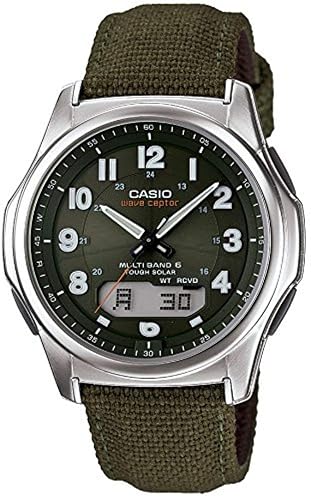
The Casio WV-58A Waveceptor is a black digital watch that sets its own time from a radio signal. And that one trick is why people buy it. You pick your time zone once, and from then on the watch corrects itself, including the date and the daylight saving change, as long as it can hear a signal. Add a backlight, a countdown timer, a stopwatch, an alarm and 50 metres of water resistance, and you have a plain, useful everyday watch that asks very little of you. The catch is geography: this model listens to the US and UK transmitters only. Here is what that means in daily life, what else it does, and who should buy it.
Product offers are temporarily unavailable.
What “atomic” really means here
There is no atomic clock inside this watch, and it is worth saying so plainly. The word “atomic” in the product name refers to the source of the time it receives. Government time services run atomic clocks, and some of them broadcast the time as a low-frequency radio signal. A radio-controlled watch contains a small antenna and a receiver that picks up that signal, reads the time and date from it and corrects the quartz movement. Between corrections the watch keeps time like any other quartz watch.
The idea is old, but it only became cheap in the last couple of decades. Casio’s Wave Ceptor line is its radio-controlled range, and the WV-58A sits at the plain, low-cost end of it. Casio says there are six transmitters in the world that broadcast the signal: Mainflingen in Germany, Anthorn in the UK, two in Japan, one near Fort Collins in the United States, and one at Shangqiu in China. Its Multi-Band 6 watches can receive all six. The WV-58A is not one of those. A retail listing gives it the US and UK signals only, both at 60 kHz.
The important limit: where it can receive
This is the point to settle before you buy. A watch that can only receive WWVB (the US signal from Fort Collins, Colorado) and MSF (the UK signal from Anthorn) will do its automatic trick well across most of North America and the UK, and not elsewhere. Casio’s own manuals quote a reception range of about 3,000 km for the US signal and about 1,500 km for the UK and German signals. So reception falls away with distance and with local interference.
If you live in the US or the UK, that is perfect. If you live in the middle of Europe, in Asia or in Australia, the watch will most likely never receive a signal. And it will behave like an ordinary digital watch that you set by hand. That is not a defect, it is simply the design. For Europe, look for a model that lists DCF77, the German signal, or a Multi-Band 6 model. Because Amazon ships the same listing to many countries, it is easy to buy the wrong version by accident. So check the signal list on the product page.
Specs at a glance
Retail listings agree on the broad strokes and disagree on a few details. So use this as a guide and compare it with the page you are actually buying from.
- Time signal: US (WWVB) and UK (MSF), 60 kHz, with automatic reception about six times a day and a manual receive button.
- Accuracy without signal: about plus or minus 20 seconds a month, according to one listing.
- Water resistance: 50 m.
- Battery: CR1620, with sources quoting about two to three years.
- Size: roughly 42 mm wide, about 51 mm long and 11 mm thick on one listing, while others describe a 43 to 44 mm case. Check the exact numbers before you buy.
- Functions: daily alarm, hourly time signal, countdown timer, 1/100-second stopwatch, world time, calendar.
- Light: automatic EL backlight with Afterglow.
- Strap: black resin with a buckle.
Some listings call out a mineral dial window and some a resin one, and some call the case stainless steel. Meanwhile, others focus on the resin build. Casio sells several variants and colours under the WV-58 family name. So a different listing may describe a slightly different watch. Read the title, the model number and the specs together instead of trusting any single line.
Living with it day to day
The display is the first thing you notice. It is a plain monochrome screen with large digits for the time and a smaller line for the date. And it is easy to read in daylight. The backlight is the automatic EL kind, which lights up the whole display evenly. And the Afterglow feature keeps it glowing for a moment after you turn your wrist. That sounds like a small thing until you check the time in a dark cinema or a bedroom at night.
The everyday functions are the standard Casio set, done well. You get a daily alarm and an hourly chime that can be switched off, a countdown timer that is handy for cooking or a workout interval, and a stopwatch that measures in hundredths of a second. The world time function shows the time in other cities, which makes sense for a radio-controlled watch that is already good at knowing what time it is. One retail listing says the weekday can be shown in nine languages, a detail that mostly matters if you travel for work.
Operation is simple. Three or four buttons run everything, and the menus are not hard once you have done it twice. If you ever lose the manual, Casio’s support site has one for the module. The first setup takes a few minutes: choose the home city, switch on daylight saving if you do not rely on the signal for it, and leave the watch near a window overnight for its first synchronisation.
Getting a good radio signal
Low-frequency signals are weak and easily disturbed, which is why watches try at night. A few habits make reception far more reliable. Put the watch near a window overnight, with the 12 o’clock side pointing toward the transmitter if you can work that out. Keep it away from computers, televisions, chargers and other electronics, which add noise. Steel buildings, basements and thick concrete block the signal. So a watch on a bedside table in a modern apartment block may struggle.
If the watch has not synchronised for a while, you can force a manual reception and leave it for a few minutes. The display shows a signal indicator, and it tells you whether reception worked. Owners who wear the watch under long sleeves, or leave it in a drawer, sometimes find it stops updating, and a night on a windowsill usually fixes that. None of this is difficult, but it is the one part of the watch that asks for a tiny bit of care.
Size, comfort and the strap
The WV-58A is a mid-size watch. It is not slim, since the case is about 11 mm thick on the dimensions quoted. But the resin strap and the light build make it comfortable for all-day wear. On a small wrist it will look large, and it will not slide under a tight cuff. So a smaller wrist may prefer a smaller digital. On an average or larger wrist it looks proportionate, and the black finish keeps it discreet.
The resin strap is soft and flexible, easy to clean and unbothered by sweat. Resin straps wear out over the years. So plan on replacing it at some point, and check the lug width before ordering a new one. If you like to change the look, standard replacement straps are widely available for Casio digitals.
Product offers are temporarily unavailable.
Water resistance and toughness
The watch is rated to 50 metres. That number is a test pressure, not a depth you should reach. In practice it means rain, washing hands, doing the dishes and a short, gentle swim are all fine. One retail listing says it suits short periods of recreational swimming but not diving or snorkelling. And that is the sensible way to read it. If you want a watch for regular swimming, look for 100 m or more. Our everyday watch guide explains what these ratings mean in more detail.
As for toughness, treat it as a sturdy daily watch, not a bomb-proof one. Some store descriptions call it shock resistant. But it does not belong to Casio’s G-Shock line, and it is not built for heavy impacts. It will cope with the usual knocks of office life and weekends. And the resin strap and case forgive a lot. A hard blow against a wall can still crack the display window.
Battery life and accuracy
The WV-58A takes a CR1620 cell. Sources quote anywhere from about two to three years of life, which is shorter than a basic digital with no radio, because the receiver draws power each time it tries to synchronise. Heavy use of the backlight shortens it further. When it is time to replace the cell, have the watch opened by someone who will check the gasket, because opening the case is the moment water resistance can be lost.
Without a signal the watch is as accurate as any quartz watch, which is to say within seconds a month. With a signal, it is corrected regularly. Wikipedia notes that daily synchronisation keeps radio-controlled Wave Ceptors accurate to a fraction of a second, which is far better than you can read from a normal watch display. For everyday life this means you can stop thinking about the time being a few seconds off. If you are curious about how a quartz watch keeps time between corrections, our explainer on how a quartz watch works goes through it step by step.
Strengths and weaknesses
What it does well. It sets itself, including the date and daylight saving, which means no more fiddling twice a year. It is light and comfortable, easy to read. And it has the useful extras: alarm, timer, stopwatch, world time and a good backlight. Its simple looks go with most clothes and it asks for little attention, apart from a battery change every couple of years.
Where it falls short. Reception is limited to the US and UK transmitters. So buyers in many other places get no benefit from the main feature. It is not a slim watch. The resin strap will eventually wear out. It is also not a rugged sports watch, and 50 m of water resistance is enough for splashes and swims but not for water sports.
Who should buy it, and who should not
It suits people in the US and the UK who like their watch to look after itself, such as commuters, teachers, nurses, shift workers and travellers who set many alarms. It also suits anyone who wants a dependable plain digital and values the radio feature on top. If you often forget to change the clocks or you check the exact time for work, the self-setting function is a quiet luxury.
Skip it if you live outside the signal areas, because a cheaper digital will serve you equally well. Skip it if you need a slim watch for a suit or heavy-duty shock protection. A simple digital such as the Timsty LED sports watch or the Affute military-style watch covers the basics, and our list of the best watches under $100 shows what else is out there. If light-powered watches appeal more than batteries, read how a solar watch works, since some radio-controlled models are also solar-powered.
Buying tips
Check the model number on the listing. WV-58A-1AV is the black resin version discussed here, and Casio sells related WV-58 variants, including ones with metal bands, that look similar but are not identical. Confirm which signals the listing says it receives, particularly if you are buying from outside the US. Look at the date of the stock too, because a watch that has sat in a warehouse for years may have a weakened battery. Prices change often and differ between sellers, so compare the current listing rather than relying on an old figure.
It is also worth thinking about alternatives in the same family. Casio’s Multi-Band 6 models can receive all six transmitters, which makes them better choices if you travel widely or live outside the US and UK. They usually cost more and are often solar-powered, so they trade a higher price for much wider coverage.


Casio WV-58A FAQ
Does the Casio WV-58A work in Europe?
Not reliably. This model is listed as receiving the US WWVB and UK MSF signals, both on 60 kHz. Casio quotes a reception range of roughly 1,500 km for the UK signal. So much of continental Europe is out of reach. Outside the signal areas it still works as a normal quartz watch, you just set the time by hand.
How accurate is it without a radio signal?
One retailer listing gives an accuracy of plus or minus 20 seconds a month with no signal calibration. Casio’s wider Wave Ceptor range is usually described as accurate to about 15 seconds a month without synchronisation, which is the normal level for a quartz watch.
How often does it receive the time signal?
The listing describes an automatic receive function that runs six times a day, plus a manual receive button. In practice the watch tries mostly at night, when radio interference is lowest. So it helps to leave it somewhere with a decent signal.
What battery does the WV-58A use and how long does it last?
It takes a CR1620 cell. Retail sources quote roughly two to three years. So treat that as an estimate and expect it to shorten if you use the backlight and the signal receiver a lot.
Is the WV-58A waterproof?
No watch is truly waterproof. It is rated 50 m, which covers rain, washing hands and short, gentle swims. But it is not meant for diving or snorkelling, and you should not press buttons underwater.
Is it a G-Shock?
No. It is a Wave Ceptor, Casio’s radio-controlled line. And it does not carry the heavy shock-resistance engineering that G-Shock is known for. Think of it as a tidy everyday digital with an automatic time-setting trick.
Do I need to set the time zone?
Yes, you choose your home city or time zone once, and the watch handles the rest. Daylight saving changes are applied automatically when the watch receives the signal, which is the main convenience of a radio-controlled watch.
Is a radio-controlled watch worth it compared with a plain digital?
If you hate setting clocks and live inside a supported signal area, yes. If you live elsewhere, or you simply want the cheapest possible watch, a plain digital does the same daily job with less to think about.
The verdict
The Casio WV-58A is a sensible, no-nonsense digital watch with one clever feature, and whether it is a good buy comes down to where you live. In the US or the UK, the automatic time setting works as promised and turns a basic digital into something you never have to adjust. Everywhere else, it is just a digital watch, and a simpler one will do the same job. Check the signal list before you buy, give it a night by a window for its first sync. And it should keep you on time for years.


